
Participants gain a deeper understanding of EU integration through Trade Academy
What does Trade Academy EU Integration offer in practice? Four participants share how the programme has deepened their knowledge of the EU and provided practical insights they can apply in their work.
Over eight months, participants combine online learning with sessions in Stockholm focused on EU decision-making, trade and the single market. The programme also provides opportunities to exchange experiences with experts and peers from candidate countries and EU member states.
Bekri Ajdini from North Macedonia will use the knowledge gained to support his country’s preparations for EU membership
Why did you want to participate in Trade Academy EU Integration?
Trade Academy EU Integration represents an exceptional opportunity for civil servants engaged in the EU integration process to deepen their understanding of how the European Union functions in practice.
As a professional working in foreign trade, I was particularly interested in gaining knowledge about the EU single market, the free movement of goods and services, and international trade within the European framework. I want to enhance my expertise in these areas to contribute more effectively to my institution and my country’s broader EU integration process.
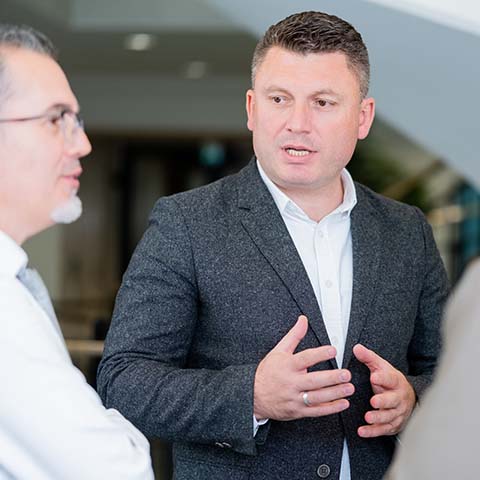
Bekri Ajdini, Counsellor at the Ministry of Foreign Affairs and Foreign Trade of North Macedonia
What are your key takeaways?
The training has been exceptionally well structured, combining foundational and practical knowledge of the European Union and its integration processes. It provided insights into the EU institutions, their roles and responsibilities, and the union’s legislative and policy-making framework.
During the training in Stockholm, practical negotiation exercises and simulations enhanced our understanding of diplomatic and technical processes. The sessions on the role of experts in preparing legislation and on strategic communication were also valuable. Through examples and case studies, we gained practical insights into regulatory compliance and market access procedures.
How will you use what you have learned?
The training has given me a clearer perspective on trade-related legislative requirements, their practical implementation, and the standards candidate countries are expected to meet.
As North Macedonia advances towards EU membership, this knowledge will help me contribute to institutional coordination, policy alignment and institutional preparedness. It will also be valuable for supporting companies from North Macedonia seeking to expand within the EU market and internationally.
The programme has supported Mariana Rufa’s work to involve businesses in Moldova’s legal harmonisation process
Mariana Rufa is the CEO of the European Business Association (EBA), one of the largest business associations in the Republic of Moldova.
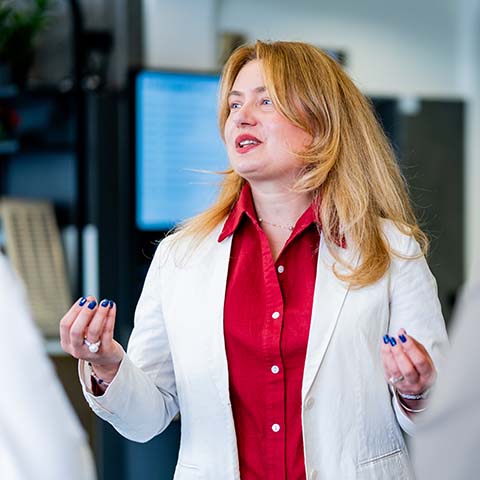
Mariana Rufa, CEO, European Business Association, Moldova
What have you gained from the programme?
I gained a much deeper understanding of how the European Union functions—from its institutional framework and decision-making processes to the roles and responsibilities of its institutions.
The programme also provided valuable insights into access to the EU single market and the dynamics of EU negotiation processes. I can apply this practical knowledge to the EU–Moldova integration agenda and the EBA’s policy and advocacy agenda.
What makes the Academy particularly valuable?
It combines strong theoretical foundations with a highly practical, application-oriented approach. Participants benefit from learning about EU member states’ best practices while engaging in meaningful exchanges with peers from candidate countries, creating a valuable platform for sharing experiences and perspectives.
I was especially impressed by the high level of professionalism demonstrated by the lecturers and experts involved in the programme.
How are you applying the knowledge in your work?
The knowledge gained has already proven useful in my daily work on the legal harmonisation process and on how we can better involve businesses in it.
Building on these insights, and in cooperation with the Economic Council to the Prime Minister and the Ministry of Economic Development and Digitalization, we launched a communication process with business associations to improve awareness and understanding of the Services Directive in the Republic of Moldova.
Trade Academy, implemented by the National Board of Trade, offers practical knowledge, expert guidance and valuable regional networking. I sincerely encourage all eligible professionals to take advantage of this outstanding programme.
Trade Academy has helped Sofiia Kostytska bridge the distance between knowing what needs to happen and knowing how to make it happen
Sofiia Kostytska applied to Trade Academy EU Integration because she wanted to understand not only how the EU institutions work, but how countries build influence and protect their interests within the system.

Sofiia Kostytska, Senior Lawyer, Reform and Support Team, Ministry of Economy and Environment, Ukraine
What did you want to understand better through the programme?
Ukraine’s candidate status is gradually shifting our relationship with the EU from spectator to participant. We are no longer watching from the outside, but we are not yet inside. Understanding how a system works does not always mean understanding how to move within it.
Before the programme, I had a clear picture of the architecture of the EU institutions and the way a proposal becomes a directive. I was less sure about how a country builds influence and protects its interests within that system.
What are your key takeaways?
The programme gave us a view from the member state side of the table through practitioners who carry the weight of the decisions they describe.
Three takeaways travel back to Kyiv with me. The first is that communication is the strategy itself. The second is the importance of coordination: a common position should reflect the interests of political decision-makers, businesses and citizens. The third is the importance of evidence-based policy. Policies that are not grounded in facts may fail through implementation.
How will you use what you have learned?
The programme has given me technical knowledge about free trade agreements, the EU Single Market, digital trade and sustainability. Just as valuable is understanding how countries shape what is drafted and decided in Brussels by engaging early and finding like-minded partners.
I want Ukraine to reach EU membership having shaped the process, not just survived it. Trade Academy has helped bridge the distance between knowing what needs to happen and knowing how to make it happen.
Robert Çeço from Albania sees close links between economic competitiveness and the country’s EU integration process

Robert Çeço, Coordinator Cluster 3, Prime Minister’s Office, Albania
Why did you want to participate in Trade Academy EU Integration?
I saw it as an opportunity to strengthen my understanding of EU trade policy, market access requirements and trade-related aspects of the EU integration process.
My work in Albania requires close coordination on policies connected to competitiveness, economic development, and alignment with EU standards. I was also motivated by the opportunity to exchange experiences with professionals from different countries and institutions working on similar challenges.
What are your key takeaways?
One of my key takeaways has been a deeper understanding of the relationship between trade promotion, economic competitiveness and EU integration.
I have also gained a clearer perspective on how trade-related reforms and capacity-building can strengthen alignment with EU practices at the current stage of Albania’s negotiation process. Another important aspect has been learning from practical examples and discussions with experts and participants from diverse professional backgrounds.
How will you use what you have learned?
The knowledge gained can directly support my work in coordinating EU integration matters, both among institutions in Albania and with the European Commission.
It has also enhanced my understanding of the challenges businesses face when accessing EU markets and the importance of institutional coordination in supporting trade competitiveness. Ultimately, I aim to support reforms and initiatives that strengthen Albania’s institutional capacities, foster sustainable economic development and increase the participation of Albanian businesses in European markets.