

Mind the Gap: Sustaining Trade and Development after Least Developed Countries' Graduation
This week, the World Trade Organization, WTO, hosts the 2026 Global Review of Aid for Trade. In Geneva, trade and development practitioners are gathering to take stock of efforts to ensure that trade contributes to sustainable development.

Senior Trade Policy Adviser Malin Ljungkvist
The meeting in Geneva coincides with a historic shift in global development. In total, 14 of the world’s 44 Least Developed Countries (LDCs), representing over 400 million people, are currently on track to be lifted from the United Nations LDC category. They will “graduate” because of sustainable development achieved in income, human capital, and economic and environmental vulnerability.
Countries such as Senegal, Lao PDR, Bangladesh and Nepal will graduate within the next few years. In addition, Rwanda, Tanzania, Uganda and others are likely to do so in the near future. While this marks a monumental success in the fight against poverty, the transition brings significant trade challenges at a time when official development assistance is becoming scarcer.
Leaving the LDC category means losing vital trade privileges. Many major economies, including the EU, the UK, China, Japan and Canada, grant LDCs duty-free and quota-free market access. Post-graduation frameworks exist, but on less generous terms. Graduating states also stand to lose WTO flexibilities and access to dedicated trade-related technical assistance.
Aid for Trade can help bridge the gap.
LDCs that are not graduating may benefit as some competitors lose preferential access to important markets, but they also face the risk that changing trade patterns could create new competitive disadvantages.
Trade-related donor support, Aid for Trade, can contribute to governments’ efforts to identify these changes and respond to both opportunities and risks.
Both graduating LDCs and those remaining in the category will need to adjust to new terms of trade. Aid for Trade can help bridge the gap, for example by strengthening private-sector competitiveness, lowering trade costs and improving infrastructure. Donors could also support compliance with the sustainability and climate conventions required to benefit from, for example, EU trade preferences after graduation.
A central challenge is timing. This wave of LDC transitions coincides with a severe global contraction in development finance. Current projections indicate that 2026 will be the third consecutive year of declining global Official Development Assistance.
The diagram shows the declining levels of Official Development Assistance (ODA) in billion US dollars.
Even though Aid for Trade volumes may appear more stable, the underlying financing structure shows a significant shift away from grants and towards loans.
The diagram shows the decreasing share of grants in Aid for trade in billion US dollars.
This trend conflicts with international commitments. The EU’s strategic commitment to allocate 25 percent of its Aid for Trade to LDCs is a vital benchmark. However, the impact of such targets is severely diluted if the total global aid envelope continues to shrink.
Trade policy must provide predictable pathways from unilateral LDC preferences towards permanent trading arrangements. Predictable, phased pathways towards permanent, development-conducive arrangements should be explored. The EU’s Economic Partnership Agreements demonstrate how asymmetric, long-term and WTO-compatible market access can support developing partners.
In this context, Aid for Trade that increases capacity for trade policy and regulation can be particularly cost-efficient and catalytic. This could assist LDCs in determining trade policy priorities and negotiating appropriate future trade arrangements.
Continued ambitious levels of Aid for Trade, backed by supportive trade policies, are essential to transform LDC graduation into resilient, long-term economic development.
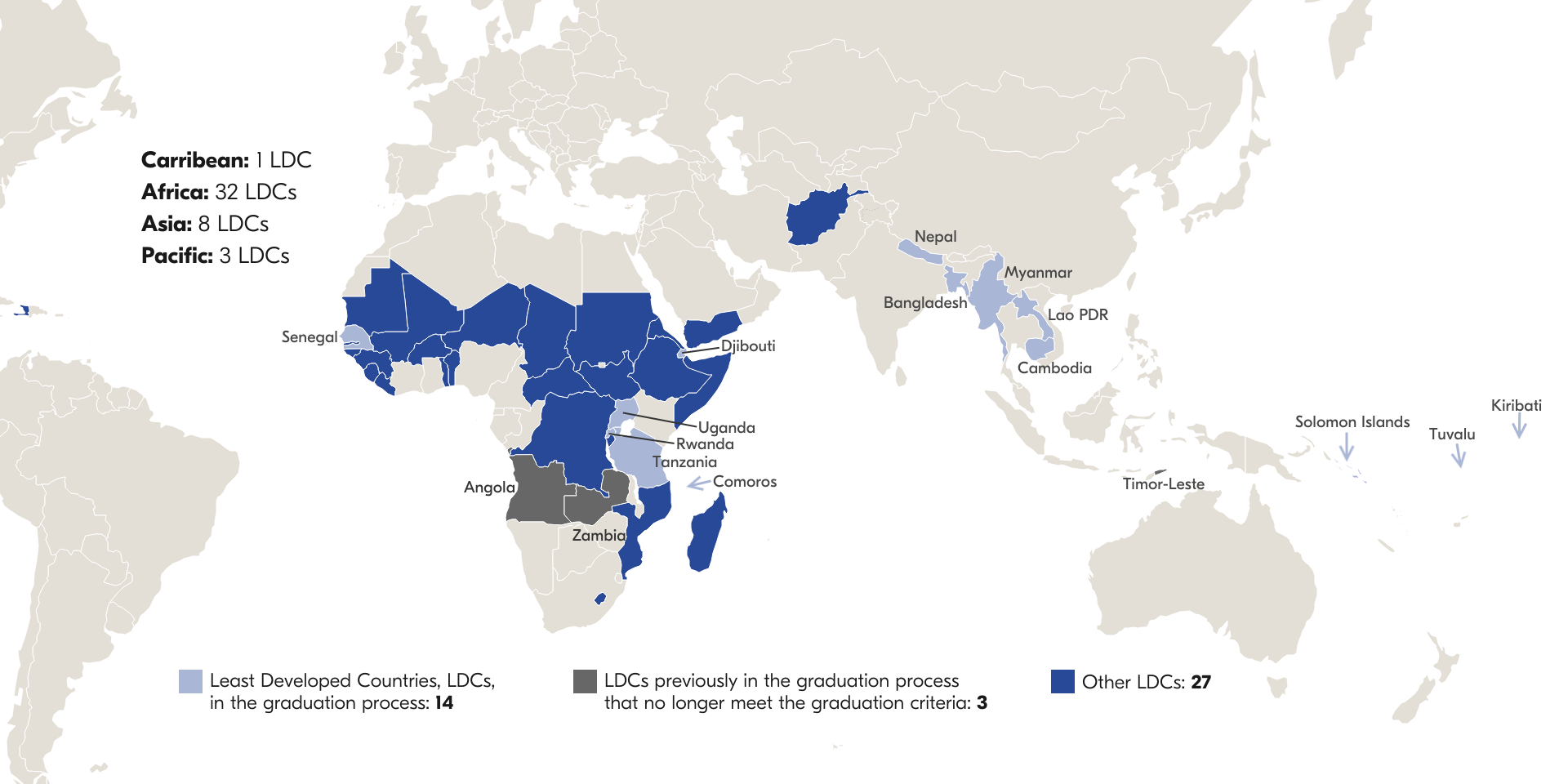
The map shows the progress of Least Developed Countries towards graduation.
Malin Ljungkvist
Senior Trade Policy Adviser
Subscribe to Trade Policy Insights
This article is part of a series of commentaries – Trade Policy Insights – connecting world trade issues with evidence-based analyses. Do not miss any new post. Sign up to get email updates when there is a new Trade Policy Insight.